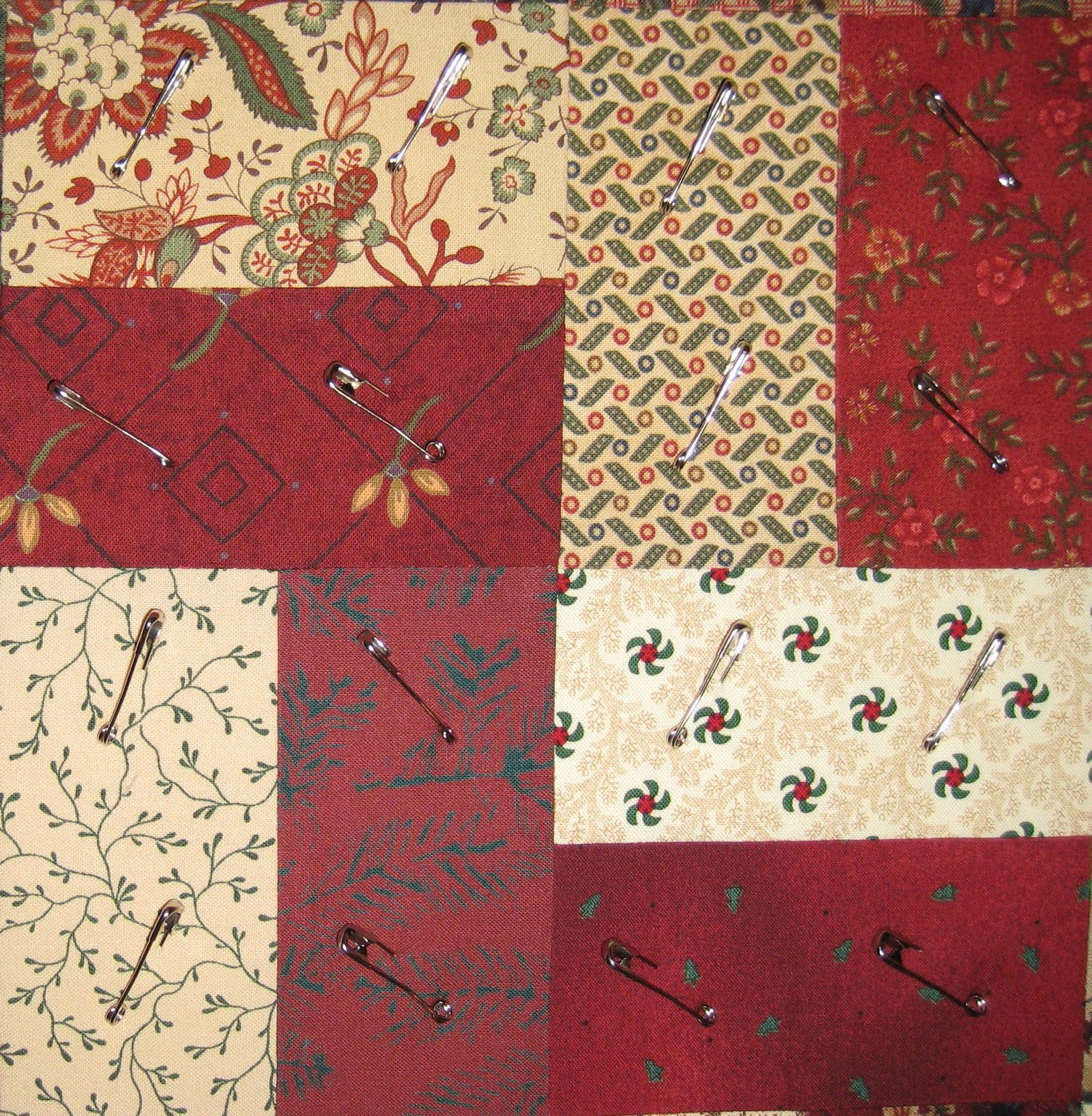
The quilt is pinned - rather heavily I might add. I am a very methodical pinner. For each block I determine the best way to pin considering how it will be quilted. It then follows that all blocks will be pinned the same way. There are 11 pins in the star blocks, 13 in the Delectable Mountain blocks, and 16 in the four-patch blocks. I use a lot of pins because the first step will be to quilt the long vertical and horizontal seams between the blocks and I want to keep the intersections of each group of 4 blocks as square as possible.
It took a long time to upload that picture. I had to eat cookies while waiting. Anyway...
I am using one of my favorite battings, Quilters Dream Cotton, in Request (thinnest) weight and Aurifil 50/2 thread in tan (color number 2325). I put a new Schmetz Microtex sharp needle (80/20 size) in the sewing machine because there are thick seams in some places. (Normally I use Schmetz Microtex Sharp 70/10 with the 50/2 thread.) The stitch length is set on 2.3. The walking foot is on. I am ready to start.
I am at the stage where I think this quilt is going to be great. At some point (generally around the half-way point) it is inevitable that I will despair and think it is not going to be great because one thing or another didn't turn out as well as I hoped. At that point you just have to forge ahead and work through the despair. As I hit the home stretch, I am usually very happy with the quilt.
Saturday, February 11, 2012
Thursday, February 9, 2012
Camping with the girls
This is a Miss Rosie's Quilt Co. pattern called Elizabeth. I named my quilt Camping With the Girls because I purchased the pattern on the way to one quilt camp and pieced the blocks at another quilt camp...and no boys were present at either camp! The quilt is 68" x 68".
I just finished sewing all the rows together so ignore the fact that it is not quilted yet. Ignore the amateur photography with distorted blocks and poor lighting. Ignore any stray threads you might see with your eagle eyes. While this quilt is not exactly the same coloring as the photo on the pattern, it has the same look. I love, love, love a quilt like this. It is warm and cozy and comforting. Bright and white quilts don't create the same feeling for murky me.
The quilt contains three kinds of blocks - Sawtooth Star, Delectable Mountain, and Four-Patch - set on point. This makes the quilt interesting, but it also complicates the pressing. The pattern gives good directions, which I did not follow 100%. I thought I knew better, but that was not always true. However I would probably do it my way again if I ever make this quilt again. I can be stubborn. Oh, yeah.
The quilt is actually a medallion design with the four Delectable Mountain blocks in the center. Then there is a row of Sawtooth Star blocks on all four sides with Four-patch blocks in the corners. And so forth. This is a closeup of the quilt center:
Normally a medallion quilt is assembled from the center out. Because all of the blocks in this quilt are the same size (8" finished), the blocks are sewn into rows and then all of the rows are attached to each other.
There are at least fifty prints in this quilt. That makes the top more interesting and creates a texture before any quilting is done. The lightest prints are in the background of the star blocks and in part of the Delectable Mountain blocks. There is a range of tan or taupe with red prints in the Delectable Mountain and the Four-patch blocks. The centers of the stars are shades of red with some rust mixed in. The star points and Delectable Mountain points are a range of browns. A few prints had green or blue in them. While piecing, I occasionally wondered if a particular block was going to be too different to use with the other blocks. If so, I would make a replacement block. In the end, all of the original blocks were used. No replacements were needed.
Here are closeups of two other sections of the top:
Next step --> prepare the backing and pin the quilt. I chose not to mark quilting lines because the fabrics in the top are too varied and generally too dark for easy marking. This top may require a Golden Thread paper solution.
I just finished sewing all the rows together so ignore the fact that it is not quilted yet. Ignore the amateur photography with distorted blocks and poor lighting. Ignore any stray threads you might see with your eagle eyes. While this quilt is not exactly the same coloring as the photo on the pattern, it has the same look. I love, love, love a quilt like this. It is warm and cozy and comforting. Bright and white quilts don't create the same feeling for murky me.
The quilt contains three kinds of blocks - Sawtooth Star, Delectable Mountain, and Four-Patch - set on point. This makes the quilt interesting, but it also complicates the pressing. The pattern gives good directions, which I did not follow 100%. I thought I knew better, but that was not always true. However I would probably do it my way again if I ever make this quilt again. I can be stubborn. Oh, yeah.
The quilt is actually a medallion design with the four Delectable Mountain blocks in the center. Then there is a row of Sawtooth Star blocks on all four sides with Four-patch blocks in the corners. And so forth. This is a closeup of the quilt center:
Normally a medallion quilt is assembled from the center out. Because all of the blocks in this quilt are the same size (8" finished), the blocks are sewn into rows and then all of the rows are attached to each other.
There are at least fifty prints in this quilt. That makes the top more interesting and creates a texture before any quilting is done. The lightest prints are in the background of the star blocks and in part of the Delectable Mountain blocks. There is a range of tan or taupe with red prints in the Delectable Mountain and the Four-patch blocks. The centers of the stars are shades of red with some rust mixed in. The star points and Delectable Mountain points are a range of browns. A few prints had green or blue in them. While piecing, I occasionally wondered if a particular block was going to be too different to use with the other blocks. If so, I would make a replacement block. In the end, all of the original blocks were used. No replacements were needed.
Here are closeups of two other sections of the top:
Next step --> prepare the backing and pin the quilt. I chose not to mark quilting lines because the fabrics in the top are too varied and generally too dark for easy marking. This top may require a Golden Thread paper solution.
Wednesday, October 5, 2011
Playing with my nickels
I have been playing with my nickels, a.k.a. 5" squares of cotton.
These are not to be confused with nickels, a.k.a. 5 cent coins.
These nickels are not equal. 5" squares cost more than 5 cents. Some quilt shops sell charm packs which are usually an assortment of 5" squares from a collection. Charm packs are a good way to get a sample of each fabric in a line and a good way to get an assortment of fabrics for scrap quilting. When purchased, the squares average 15-20 cents each. I rarely buy the "ready made" charm packs.
Some quilters cut virgin fabric into nickels. Virgin fabric is fabric that was purchased, but has never been cut into and is therefore still in pristine condition. I don't do that. I cut nickels from remnants of finished projects when the pieces left over are too small to fold and stack on my shelves. If not used this way, the scraps might have been discarded. This makes me feel very economical.
Nickels are easily stored in a Rubbermaid tub. They are great to take along for a sewing day at someone's house. They eliminate the need to plan ahead and cut pieces for a project. There are even books showing many blocks that can be made entirely from nickels. Enough about the merits of nickels.
These 4 1/2" units were made from nickels.
It took 120 of the units to make this 40" x 48" top.
I have enough made for another top the same size. Both will be donated to a nursing home.
These are not to be confused with nickels, a.k.a. 5 cent coins.
These nickels are not equal. 5" squares cost more than 5 cents. Some quilt shops sell charm packs which are usually an assortment of 5" squares from a collection. Charm packs are a good way to get a sample of each fabric in a line and a good way to get an assortment of fabrics for scrap quilting. When purchased, the squares average 15-20 cents each. I rarely buy the "ready made" charm packs.
Some quilters cut virgin fabric into nickels. Virgin fabric is fabric that was purchased, but has never been cut into and is therefore still in pristine condition. I don't do that. I cut nickels from remnants of finished projects when the pieces left over are too small to fold and stack on my shelves. If not used this way, the scraps might have been discarded. This makes me feel very economical.
Nickels are easily stored in a Rubbermaid tub. They are great to take along for a sewing day at someone's house. They eliminate the need to plan ahead and cut pieces for a project. There are even books showing many blocks that can be made entirely from nickels. Enough about the merits of nickels.
These 4 1/2" units were made from nickels.
It took 120 of the units to make this 40" x 48" top.
I have enough made for another top the same size. Both will be donated to a nursing home.
Tuesday, July 26, 2011
Enjoying my stash
I am the kind of quilter who likes to collect great fabric. Then someday I use it. Once in awhile I keep it too long and no longer love it, but that is a different story. For years I collected fabrics that would be good for baby quilts. I had absolutely no idea how those fabrics would be used. Last week I went to my stash to find ingredients for a baby quilt. My eyes settled on this delightful, funky plaid:
There was enough for the background of a quilt. I decided to pull fabrics to match the colors in the plaid. This is what I selected:
The red on the right was perfect because it had bits of pink that matched the pink on the left. The yellow was good because it had a lot of variation, looking bright yellow in some places and orange in others. I chose not to include a fabric the color of the deep blue in the plaid. It seemed too bold for what I had in mind.
The pattern was one I'd made many times so it went together quickly. The block are set on point. The quilt has setting triangles. In the past I've cut all setting triangles from the same fabric. This is the first time for using scrappy setting triangles. This is the finished (unquilted) top:
It's a happy quilt!
I will cut bias binding strips from the plaid. Today I hope to find the perfect back for it. Can't wait to see it finished.
There was enough for the background of a quilt. I decided to pull fabrics to match the colors in the plaid. This is what I selected:
The red on the right was perfect because it had bits of pink that matched the pink on the left. The yellow was good because it had a lot of variation, looking bright yellow in some places and orange in others. I chose not to include a fabric the color of the deep blue in the plaid. It seemed too bold for what I had in mind.
The pattern was one I'd made many times so it went together quickly. The block are set on point. The quilt has setting triangles. In the past I've cut all setting triangles from the same fabric. This is the first time for using scrappy setting triangles. This is the finished (unquilted) top:
It's a happy quilt!
I will cut bias binding strips from the plaid. Today I hope to find the perfect back for it. Can't wait to see it finished.
Saturday, May 14, 2011
Quilting the big ones
People often ask how to manage the bulk of a large bed size quilt on a home sewing machine. The one I am working on now - Big ZZ - is 95" x 95". I am still quilting the long vertical zigzags in the ditch. I started by rolling the quilt from one side to the center zigzag. I put it under the machine with the roll on the right and the unrolled portion to the left. I wish I'd taken a picture at that point. The roll seemed really big.
After I had quilted in the ditch on both sides of one zigzag, I removed the pins from that zigzag. Removing pins is a milestone for me. Makes me feel encouraged. Then I quilted the next vertical line and got to remove more pins. Another milestone. After I had quilted several more vertical lines and removed more pins, I started thinking the the roll was no longer so big. More encouragement.
This is how the quilt looks right now.
The first thing I ever read about packaging the quilt said to roll up both sides towards the center and to keep the package neat and compact as you worked. Every time you unrolled the right side, you were supposed to roll up the left side. I tried that, and it did not work for me. I spent too much time and effort trying to keep the package neat. My machine sits on top of a table so I don't have a large flat quilting surface. It seemed like the roll on the left kept jerking the package in the wrong direction and making my quilting eratic. Eventually I decided that it was better to keep the left side piled up so it was free to move around and less likely to get caught on the corner of my machine.
Notice the chair pushed up to the table in the lower left corner of the picture. That is a quilting fence. It keeps the quilt from falling off the table and jerking the package in the wrong direction. There are also 3 chairs pushed up to the table on the opposite side, but they are not visible in the picture.
The child in me is wondering how many more vertical lines I have to quilt before I reach the edge. It's an are-we-there-yet thing. The adult in me does not want to unroll the package to find out because it would require me to take it out of the machine and roll it up again. That is not my favorite part.
Back to quilting.
After I had quilted in the ditch on both sides of one zigzag, I removed the pins from that zigzag. Removing pins is a milestone for me. Makes me feel encouraged. Then I quilted the next vertical line and got to remove more pins. Another milestone. After I had quilted several more vertical lines and removed more pins, I started thinking the the roll was no longer so big. More encouragement.
This is how the quilt looks right now.
The first thing I ever read about packaging the quilt said to roll up both sides towards the center and to keep the package neat and compact as you worked. Every time you unrolled the right side, you were supposed to roll up the left side. I tried that, and it did not work for me. I spent too much time and effort trying to keep the package neat. My machine sits on top of a table so I don't have a large flat quilting surface. It seemed like the roll on the left kept jerking the package in the wrong direction and making my quilting eratic. Eventually I decided that it was better to keep the left side piled up so it was free to move around and less likely to get caught on the corner of my machine.
Notice the chair pushed up to the table in the lower left corner of the picture. That is a quilting fence. It keeps the quilt from falling off the table and jerking the package in the wrong direction. There are also 3 chairs pushed up to the table on the opposite side, but they are not visible in the picture.
The child in me is wondering how many more vertical lines I have to quilt before I reach the edge. It's an are-we-there-yet thing. The adult in me does not want to unroll the package to find out because it would require me to take it out of the machine and roll it up again. That is not my favorite part.
Back to quilting.
Tuesday, May 10, 2011
Little zz and big zz
Zigzag, that is. Little zz (17" x 22") is quilted and bound. And very sweet.
Big zz (95" x 95") is pinned and ready to quilt. I would be less than honest if I didn't say that I am feeling...trepidation. It is so much larger than the projects I've worked on lately and very heavy with its 2000 pins. I chose to pin it every two inches to keep the fabric from shifiting and hopefully to keep it nice and square. This is how each 8" block is pinned.
The first thing I will do is (free-motion) quilt the long lines between the red/green zigzags and the lighter ones.
Even though I am feeling that trepidation, I am also excited. Right now I am going to prepare my machine and then get started.
This might take awhile...
Big zz (95" x 95") is pinned and ready to quilt. I would be less than honest if I didn't say that I am feeling...trepidation. It is so much larger than the projects I've worked on lately and very heavy with its 2000 pins. I chose to pin it every two inches to keep the fabric from shifiting and hopefully to keep it nice and square. This is how each 8" block is pinned.
The first thing I will do is (free-motion) quilt the long lines between the red/green zigzags and the lighter ones.
Even though I am feeling that trepidation, I am also excited. Right now I am going to prepare my machine and then get started.
This might take awhile...
Saturday, May 7, 2011
Saturday morning pin emergency
I have pinned the middle 40" length of a 95" x 95" quilt. The supply of pins is dwindling fast. Would my supply of 1300 one-inch curved pins be enough? The blocks are pinned very consistently with pins every 2". I did the math. I need 2052 pins. YIKES!
Time to visit my local quilt shop. Or shops. Whatever it takes.
Question: How much will the quilt weigh with over 2000 pins in it?
Time to visit my local quilt shop. Or shops. Whatever it takes.
Question: How much will the quilt weigh with over 2000 pins in it?
Subscribe to:
Posts (Atom)